





“There are important skills, values, knowledge, and experience that you can acquire prior to law school and that will provide a sound foundation for a legal education. If you wish to prepare adequately for a legal education, and for a career in law or for other professional service that involves the use of lawyering skills, you should seek educational, extra-curricular, and life experiences that will assist you in developing those attributes.”
The legal profession has a vast presence in our society via legal practice in public and private sectors, government, industries, etc. influencing and supporting the foundation of how we function in today’s world. The path to becoming a legal expert is through completion of a law school degree. Law schools offer a variety of degrees or certificates for individuals to pursue.
- Juris Doctorate (JD) Degree is for those who wish to practice law and be involved in other career paths as well.
- Master of Laws (LLM) is for those who already have a JD and want to expand their knowledge to study a specialized area of law and gain international qualification.
- Master’s Degree (M) are for those who want to study law but not practice as a lawyer. There are multiple concentrations such as Master of Science in Laws (MSL), Master of Legal Studies (MLS), and Juris Master (JM) in addition to others.
- Legal Certificate (CRT) for those who wish to broaden their knowledge of the law. This will assist those who work in highly regulated industries.
For all law school degrees, the core requirements for admission are a deep and diverse foundation in academics and extensive professional development through extra-curricular experiences.
Pre-Law Professional Development or PLS Questions?
Book a consultation or email rknicker@ufl.edu.
Book an appointmentPre-Law Professional Development
Professional development for pre-law students is a holistic process that includes academic achievement, practical experience, personal growth, and skill-building. It is not just about preparing for law school but also about developing as a well-rounded individual capable of thriving in the challenging and dynamic field of law.
According to the American Bar Association (ABA) the Core Skills, Values, Knowledge, and Experience needed are:
- Problem Solving
- Critical Reading
- Writing and Editing
- Oral Communication and Listening
- Research
- Leadership
- Organization and Management
- Public Service and Promotion of Justice
- Relationship-building and Collaboration
- Background Knowledge
- Exposure to the Law
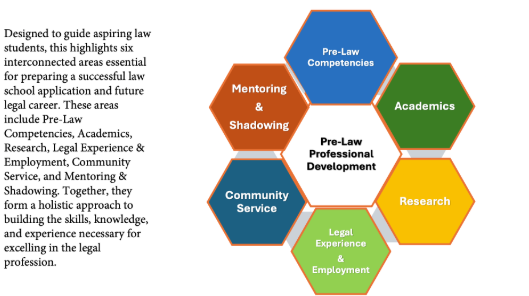
Pre-Law Areas of Engagement
This graphic provides a comprehensive overview of the key components involved in Pre-Law Professional Development. Designed to guide aspiring law students, it highlights six interconnected areas essential for preparing a successful law school application and future legal career.
Pre-Law Timeline and Application Process
Please review the comprehensive Pre-Law Timeline and Application Process. This resource provides a broad overview of the law school preparation and application process for your reference.
Keep in mind that building a competitive law school application is a highly individualized process that requires sustained academic achievement, meaningful extracurricular involvement, and thoughtful professional development. Each student’s path will vary based on their experiences, goals, and strengths.
If you have questions or would like assistance with planning your pre-law journey, we encourage you to take advantage of the advising resources available through both Beyond120 Professional Development and Pre-Law Advising. These services can help you develop a personalized strategy and make informed decisions throughout the application process.
Beyond120 Pre-Law Courses
This course is for freshman, sophomore, or new transfer students interested in pursuing admission to law school. This course provides information for students to begin personal and professional development in preparation for application to law professional programs. Students are introduced to topics related to holistic preparation including academic and extra-curricular engagement, along with intense self-reflection of strengths, values, and areas of growth.
This course – is an immersive, interdisciplinary PRE-LAW course designed to provide undergraduate students with an in-depth understanding of the diverse career opportunities within the legal field and the management strategies employed by private legal firms. The course will cover a range of topics, including but not limited to, the structure of law firms, legal specializations, client relations, firm management, and emerging trends in the legal industry. Students will engage in discussions about the various paths available within law, from litigation to corporate counsel, and will learn about the business side of legal practice, including marketing, finance, and firm culture.
Pre-Law Scholars Program
Beyond 120 provides pre-law students in the College of Liberal Arts and Sciences with resources and support for professional development and to develop a competitive application for admission to law school through the Pre-Law Scholars (PLS) program. Through a combination of academic and experiential learning opportunities you can establish depth, diversity, and valuable insights into the legal profession, aligning with the American Bar Association’s (ABA) ‘Core Skills, Values, Knowledge, and Experience.’
Join the Beyond120 Pre-Law Scholars program by attending one of our information sessions, watching the information session below and submitting the quiz on the Suitable app or scheduling a consultation with us to learn about the requirements. Then track your progress with the Pre-Law Scholars Roadmap found on Gator Launch ( Suitable app). Watch the ‘Introduction to Pre-Law Professional Development and Pre-Law Scholars’ Video.
Pre-Law Scholars Requirements
To be recognized as a Pre-Law Scholar you must complete a minimum of 10 activities in the areas below, 5 or more of which must be pre-law related.
| Area | Activities |
|---|---|
| Beyond120 Experience (Choose 1) | ▪︎ Beyond120 Academic Course ▪︎ Beyond120 CLAS Ambassador ▪︎ Beyond120 Excursion ▪︎ Beyond120 Study Abroad |
| Immersive Experiences (Choose 2) | ▪︎ Legal Employment ▪︎ Study Abroad ▪︎ Pre-law Internship ▪︎ Research ▪︎ Lsac Admission Unmasked ▪︎ Pre-law Student Organization Leadership ▪︎ Legal Shadowing ▪︎ Pre-law Summer Program ▪︎ Pls Leadership ▪︎ Community Service |
| Foundational Experiences (Choose 3) | ▪︎ Beyond120 Blog Post Entry ▪︎ Gator Network Meeting ▪︎ Beyond120 Faculty Consultation ▪︎ Beyond120 Skills Curriculum Module ▪︎ Beyond120 Or Pre-law Workshop Or Event ▪︎ Professional Conference Attendance ▪︎ Research Publication ▪︎ Attend A Court Hearing ▪︎ Attend A Law School Class ▪︎ Lsac Forum Attendance |
| Choose Your Own Experiences (Choose 4) | ▪︎ Any Beyond120 Experience ▪︎ Any Immersive Experience ▪︎ Any Foundational Experience |
FAQ’s
- Beyond120 graduation regalia
- Recognition at the Experiential Scholars Reception
- Include this accomplishment in your professional school application
You can keep track of your activities using the Pre-Law Roadmap in Gator Launch (Suitable app). Some activities require you to submit something such as a reflection, documentation, etc. Others like attending a Beyond120 workshop may be recorded for you.
No, we ask that you choose the scholars program most relevant to your goals. However, you can change the program you plan to complete at any time.
Yes! You can enter activities in Suitable at any time and have them count towards the recognition for Experiential Scholars. As long as you did the activity in college (not high school) it can count. This means transfer students can include activities like research or internships that were completed at their previous institutions.
How Do I Get Involved with PLS?

Additional Resources to Meet PLS Requirements
- LSAC Homepage: https://www.lsac.org/
Central hub for everything related to law school admissions
- LSAT Registration and Info: https://www.lsac.org/lsat
Includes registration, test dates, and preparation materials
- Credential Assembly Service (CAS): https://www.lsac.org/applying-law-school/jd-application-process/credential-assembly-service-cas
Service for application materials
- Official LSAT Prep Plus: https://www.lsac.org/lsat/prep
Prep materials
- LSAC Law School Forums: https://www.lsac.org/lawschoolforums
Local and online forums where students can meet with law school reps
- Discover Law: https://www.lsac.org/discoverlaw
Resources aimed at increasing diversity in the legal profession
- Law School Admissions Guides: https://www.lsac.org/choosing-law-school/find-law-school/jd-programs
Guides to help in the application process
- American Bar Association (ABA): https://www.americanbar.org/
Information about legal education, accreditation, and the legal profession
- National Association for Law Placement (NALP): https://www.nalp.org/
Stats on law school employment statistics and career resources
- U.S. News & World Report Law School Rankings:https://www.usnews.com/best-graduate-schools/top-law-schools
Become deeply and diversely educated by taking a diverse breadth of challenging courses to prepare for the rigors of law school.
Students are admitted to law school from almost every academic discipline. Choose a major that interests and challenges you. Focus on developing the ‘Core Skills, Values, Knowledge, and Experiences.’
In academics, this includes problem solving, critical thinking, reading, research and analysis, writing and editing, oral communication and listening, and gaining foundational/background knowledge regarding people, the profession and issues.
Areas of knowledge that might be beneficial are:
- A broad understanding of history, including the various factors (social, political, economic, and cultural) that have influenced the development of our society in the United States.
- A fundamental understanding of political thought and of the contemporary American political system.
- Some basic mathematical and financial skills, such as an understanding of basic pre-calculus mathematics and an ability to analyze financial data.
- A basic understanding of human behavior and social interaction.
- An understanding of diverse cultures within and beyond the United States, of international institutions and issues, of world events, and of the increasing interdependence of the nations and communities within our world. https://www.americanbar.org/groups/legal_education/resources/pre_law/
Subject Areas:
- Logical and Critical Thinking: Courses such as in philosophy, especially those focusing on logic, help develop critical reasoning skills. Computer science courses that will connect legal education with national and international institutions.
- Writing and Communication: Strong and precise writing skills are essential for law students. Courses in English, rhetoric, or communications will assist in the ability to express ideas clearly and effectively.
- Public Speaking: Courses in speech, debate, or rhetoric to enhance oral communication skills, which are crucial for the practice of law.
- Political Science and Government: These courses offer insights into the structure and function of government systems, legal processes, and political theory.
- History: Aid in the ability to comprehend historical contexts of legal systems, constitutional history, and influential legal cases.
- Economics: Provides an understanding of economic principles and policies, useful, especially in areas regarding corporate or tax law.
- Sociology and Psychology: Courses provide help in understanding human behavior and social systems, helpful in areas such as family, criminal, and civil rights law.
- Ethics: Courses in ethics or morals are valuable for analyzing and discerning ethical dilemmas, common to legal disciplines.
- Criminal Justice: Provides insight into legal system, criminal laws, and the justice process.
- Pre-Law Studies: Beyond120 and UF offer specific courses in legal studies or pre-law, which provides foundational knowledge regarding the legal profession.
- Research Methods: Provides the opportunity for acquiring the skills of research methods, critical thinking and decision making.
- Constitutional Law: Offers insight into the content of the Constitution, which is fundamental to all areas of American law.
(Adapted from: Pre-Law Requirements: A Guide for Law School Preparation | Bold.org)
UF Courses
Undergraduate Catalog Courses Website
Some courses may have prerequisites and may not be offered every semester. Please check the Schedule of Courses and Course Descriptions for more information. General Education and Writing designations are always subject to change. Always check for designations when you are registering.
- Askew & Haskell Scholars
- Beyond120 – CLAS and UF
- Beyond120 Research
- UF Student Legal Services
- Levin Law Faculty Research
- UF Junior Research Fellows
Present and Publish
- Center for Undergraduate Research
- UF/IFAS Research Positions
- UF Undergraduate Research Assistantship Program
- UF Undergraduate Research Database
- Emerging Scholars Program
- McNair Scholars Program
- Undergraduate Law Review
- Summer Undergraduate International Research Program
- Beyond120 Pre-Health Global Engagement – Study Abroad/Exchange Programs
- University Scholars Program
Non-UF Research Opportunities
- Research Experiences for Undergraduates (REUs)
- Research Search Engines
- Summer Programs (SURPs)
- 1000 Law Thesis Topics and Ideas – iResearchNet
Labs and Research Groups by Department
- Beyond 120 Internships
- UF Student Legal Services
- Legal Aid & Pro Bono Service
- Career Connections Center
- Sociology and Criminology & Law
- Gator Career Link Portal
- Attend and observe legal cases
- USAJOBS – The Federal Government’s official employment site
- Homepage | LSC – Legal Services Corporation: America’s Partner for Equal Justice
- UF Legal Services – Student Ambassadors
- Home – Three Rivers Legal Services Free Civil Legal Help
- The James C Adkins Jr American Inn of Court – American Inns of Court
- Office of the Public Defender 8th Judicial Circuit
- Congressional Hispanic Caucus Institute (CHDI)
- Alachua County – The Eighth Judicial Circuit of Florida
Internship Site Suggestions (be sure to research all options)
- American Bar Association
- American Civil Liberties Union
- Human Rights Campaign
- Immigration Equality
- International Law Institute
- JusticeCorps
- Koch Internship Program
- Lawyers’ Committee for Civil Rights
- FirstGEN Fellows Program
- National Immigrant Justice Center (NIJC)
- People for the Ethical Treatment of Animals
- Sponsors for Educational Opportunity (SEO)
- United Nations
- US Department of Defense (for civilians)
- US Department of State
- US Supreme Court
- World Intellectual Property Organization
- Bennett Inn of Court – Gainesville, Florida
Lists with multiple volunteer sites:
- VolunteerMatch – Where Volunteering Begins
- Nonprofit Jobs, Volunteering, and More – Idealist
- Gainesville Volunteer (List)
A few options:
- Alachua County Family Services Center
- AARP Foundation SCSEP
- Beyond 120 Internships
- Bob Graham Center for Public Service
- UF David and Wanda Brown Center for Leadership & Service
- Tacachale
- Alachua County Crisis Center
- Alachua County Library Literacy Programs
- Alachua County School Volunteer Program
- ARC of Alachua County
- Balance 180 Gymnastics and Sports Academy
- Eldercare of Alachua County
- Field and Fork
- Florida Association of Volunteer Centers (FAVC)
- Grace Marketplace
- Noah’s Endeavor
- Oak Hammock
- Peaceful Paths
- Salvation Army Homework Club: contact Shera Sherman at 352-376-1743 x 7101
UF does not endorse any programs other than the study abroad programs approved through the UF Beyond120 and the International Center. Private programs should be carefully researched. Students participate at their own risk and should be fully aware of the ethical issues involved in international volunteer programs.
- Beyond120 Global Engagement
- Beyond120 Exchange Programs
- Beyond120 Study Abroad
- Beyond120 Excursions
- College of Liberal Arts & Sciences Study Abroad
- UF Study Abroad
Other options:
Choose your student involvement based on your personal and professional interests. Please go to Find an organization – GatorConnect – University of Florida and search for options you may be interested in.
Some Pre-Law student organizations: Please search for additional options of your choosing
- Pre- Legal Honor Society
- Florida Undergraduate Moot Court
- Minority Pre-Legal Society
- Undergraduate Mock Trial Team
- First-Generation Lawyers
- Gator Society for Pre-Law Women
- Florida Undergraduate Law Review
- Journal of Florida Pre-Law Review
- Phi Alpha Delta – Pre-Law
- Florida Intellectual Property Alliance
- Florida Business Law Society
- Criminology and Pre-Law Honor Society